
Artificial intelligence (AI) has revolutionised numerous fields, from medicine to finance. However, one of the most surprising areas in which AI is making its mark is the study of radioactivity.
At first glance, it might seem like a strange combination, but AI’s ability to analyse large amounts of data and detect complex patterns makes it an invaluable tool for understanding phenomena as intricate as radioactive decay.
The law of radioactive decay describes how unstable nuclei transform into more stable nuclei over time, a process that can be modelled mathematically.
Types of radioactive decay
Radioactive decay is a natural phenomenon whereby An unstable atomic nucleus loses energy by emitting radiation. There are several types of radioactive decay, the most notable of which are:
- Alpha (α) decay: In this type of decay, an atom emits an alpha particle (two protons and two neutrons). This results in a decrease of 2 in the atomic number and 4 in the mass number. It is common in heavy elements such as uranium and radium.
- Beta (β) decay: This disintegration entails the the conversion of a neutron into a proton (or vice versa) within the nucleus, accompanied by the beta particle emission (an electron or a positron). Beta decay can be classified as beta-negative (β-) or beta-positive (β+), depending on the type of particle emitted. In the former case, a neutron is converted into a proton, emitting an electron and an antineutrino. Conversely, we refer to β+ decay when a proton is converted into a neutron, emitting a positron and a neutrino.
- Gamma (γ) decay: It often occurs following an alpha or beta decay, where The nucleus emits gamma radiation to release additional energy without changing its atomic or mass number. This is not a form of decay as such, but rather the emission of high-energy electromagnetic radiation when a nucleus transitions from an excited state to a lower-energy state.
- Electronic capture: In this process, a proton in the nucleus captures an orbital electron, turning into a neutron and emitting a neutrino. This also results in a decrease in the atomic number.
- Spontaneous fission: In it, Some heavy nuclei split spontaneously into lighter fragments, releasing neutrons and energy
Each of these types of decay has different implications both for nuclear physics and for practical applications in medicine, nuclear energy and other fields.
Exponential decay law
The law of radioactive decay is described by an exponential function that relates the number of radioactive nuclei present to the elapsed time. Mathematically, it is expressed as:
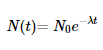
Where:
- N(t) is the number of nuclei remaining at time (t).
- N0 is the initial number of cores.
- λ is the decay constant specific to each isotope.
- e is the base of the natural logarithm.
This equation shows that the number of radioactive nuclei decreases exponentially over time. The constant λ is related to the half-life T1/2 of the isotope via the following equation:
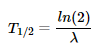
This means that after each interval equal to one half-life, approximately half of the original material will have decayed.
This exponential law has interesting applications in AI, particularly in the the design of neural networks and the optimisation of learning algorithms. For example, activation functions in neural networks often use exponential forms similar to the law of radioactive decay.
Bateman’s equations
Bateman’s equations, developed by Harry Bateman, describe the temporal evolution of a chain of radioactive decays. These equations are fundamental to describing complex processes involving multiple stages or intermediate products in nuclear reactions, and they enable the relative quantities of different isotopes to be calculated over time when there are several stages involved in the decay.
For a system with n isotopes that decay sequentially, the equations can be expressed as:
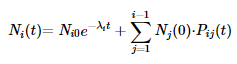
Where:
- Ni(t) is the number of isotopes (i) at time (t).
- Pij(t) represents the probabilities associated with transitions between isotopes.
These equations are particularly useful in studies of nuclear waste and industrial processes where multiple isotopes are present simultaneously. In the context of AI, Bateman’s equations can inspire models for complex systems with multiple interconnected states, such as in natural language processing or the modelling of ecological systems.
Statistical properties and statistical fluctuations
The random nature of the radioactive decay process introduces significant statistical properties. Although it is possible to predict how many nuclei will remain after a certain time using the exponential law, It is not possible to predict exactly when each individual event will occur. This gives rise to statistical fluctuations which can be modelled using probability distributions.
Binomial distribution
In contexts where large numbers of radioactive nuclei are studied, the binomial distribution can be used to model the statistical behaviour of the process. If we consider a large number N₀ of nuclei initially present and assume that each nucleus has a probability p = 1 – e⁻^λt of having decayed after a time t, then we can apply the binomial distribution:
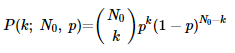
Where:
- P(k; N0, p) is the probability that exactly k nuclei have decayed.
-
(N0:k) is the binomial coefficient that counts the possible combinations.
This approach makes it possible to predict how many particles have decayed after a certain period and provides valuable information on the risks associated with radioactive materials. The statistical nature of radioactive decay offers interesting parallels with stochastic processes in AI. This distribution has applications in AI, particularly in binary classification problems and in the design of loss functions for machine learning models.
A new horizon
Exploring the links between AI and the law of radioactive decay reveals surprising parallels and opportunities for mutual learning. The statistical and mathematical principles governing radioactive decay offer inspiration for the development of more robust and efficient AI algorithms.
Furthermore, AI techniques can improve our ability to model and predict complex radioactive processes. By integrating advanced AI-based techniques — such as machine learning — we could to optimise predictive models relating to nuclear processes and improve our ability to manage radioactive waste or develop new, safer energy technologies.
The combination of physical knowledge with advanced computational tools promises to open up new frontiers in both scientific research and practical applications relating to nuclear energy and its environmental impact.



 Español
 English (UK)