
A applet is a small program that runs inside another application, usually in a web browser, with the aim of providing interactive functionalities without the need for additional installation.
For years, Java applets were one of the most popular ways of adding dynamic content to web pages, such as animations, simulations and interactive tools.
Unlike traditional applications, which run independently on the operating system, applets depend on a specific execution environment. In the case of applets in Java, this environment is the Java Virtual Machine (JVM), which allows code to run uniformly on different operating systems without modification.
How do applets work in Java?
Applets written in Java follow a specific structure and run inside the browser, provided that the browser supports Java technology. Its LIFE CYCLE is made up of four fundamental stages:
-
Charge: the browser downloads the .class file of the applet and loads it into memory.
-
Initialisation (init): an initial configuration of the applet is executed before it is displayed on the screen.
-
Execution (start and paint): applet processes are activated and their graphical content is drawn if necessary.
-
Termination (stop and destroy)when the user leaves the page, the applet stops its execution and frees resources.
A example The basic Java applet would be as follows:
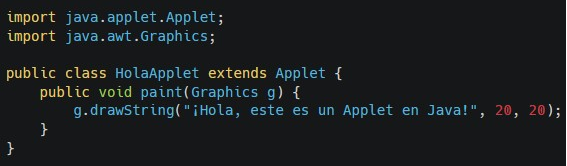
To display it on a web page, it was used the tag in HTML as follows:

When loading the page, the applet generated the message «Hello, this is a Java Applet!» inside the browser.
Functions and uses of applets
Applets were used to multiple purposes, especially in interactive web applications. Some of its main features functions were:
-
Advanced interactivitywere used to create simulations, animated graphics and educational tools.
-
Connectivity with serversThey could communicate with databases and process information in real time.
-
Local data processingThe user's computer: they performed calculations on the user's computer, reducing the load on the server.
-
Cross-platform compatibilitythanks to the Java Machine, applets could run on different operating systems without modification.
Some examples of use of applets were:
-
Scientific and financial calculators online.
-
Browser games with dynamic graphics.
-
Data visualisation applications and interactive graphics.
-
Mathematical and scientific simulations for education.
The decline of applets in Java
Despite their importance in web development, the use of applets in Java has decreased drastically over time for a number of reasons:
-
Security problemsMany vulnerabilities in the Java Machine allowed the execution of malicious code on users' systems.
-
Dependence on pluginsBrowsers required the installation of a Java plug-in to run applets, which created drawbacks in the user experience.
-
Technological advancesThe advent of technologies such as JavaScript, HTML5, WebGL and WebAssembly offered more secure and efficient alternatives for creating interactive content on the web.
Because of these problems, the major browsers removed support for Java applets and Oracle discontinued the Java Plugin in 2019. Today, web developers use modern frameworks such as React, Angular and WebGL to achieve the same effects without compromising security.
In short, applets were an innovative solution at the time, allowing interactivity to be added to web pages in an efficient way. However, they were eventually replaced by more secure and flexible technologies.
Although they are no longer used on the web, their legacy is still present in the evolution of interactive development on the Internet.



 Español
  English (UK)