
Parseo is a term widely used in the field of programme and the computer science, which refers to the process of analyse y break down a data string (such as text, configuration files, JSON, XML, amongst others) in a structure that can be understood and processed by a programme.
This process is crucial in software development, as it enables unstructured or semi-structured data to be transformed into a format that can be processed more easily.
What is parsing in programming?
At programme, parsing is the process of converting a sequence of characters (code, data, commands) within a structure syntactic that a programme can understand and execute.
This process is carried out using a «parser» o «analyser», which breaks the input down into tokens and analyses the structure in accordance with the rules defined in the grammar of the programming language or data format.
For example, in a programming language, parsing is a fundamental part of the compilation o interpretation of the source code. When a programmer writes code, that text must be translated into a internal representation that the computer can run.
The parser is responsible for reading the code and recognising the keywords and other elements syntactic, and build a data structure (such as a abstract syntax tree) which the programme represents.
What is the purpose of data parsing?
Parsing data is essential for any operation involving the reading, manipulation, and storage data in a structured format.
This process enables programmes extract useful information from a variety of input formats and convert it into an internal format that can be used for make decisions, perform calculations, o transform the information.
For example, when a file is received JSON When accessed via an API, that JSON is simply a text string.
For a programme to access the values contained in that JSON (such as lists, numbers, o chains), you must first parse it, that is, convert it into a data structure, such as a dictionary or a list in Python.
In this way, the programme can interact with the data in a logical and structured manner.
How do you parse code?
Code parsing is a process that can vary depending on the programming language and the type of data being parsed. Examples in various languages are given below:
Parsing in Python
In Python, one of the most common examples of parsing is the conversion of a JSON to a dictionary:
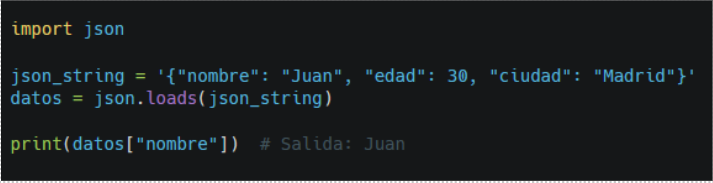
In this example, `json.loads()` parses the JSON string into a Python dictionary.
Parsing in JavaScript
In JavaScript, parsing JSON is also very common:

JSON.parse() converts the JSON string into a JavaScript object.
Parseo on C#
In C#, you can use the class XmlDocument to parse XML:
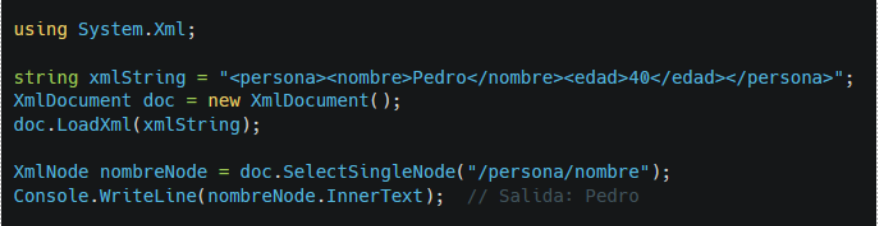
Here, LoadXml parses the XML string and allows you to access specific elements in the document.
Parsing in Java
For parsing in Java, you can use the library org.json To convert a JSON string into a JSONObject:
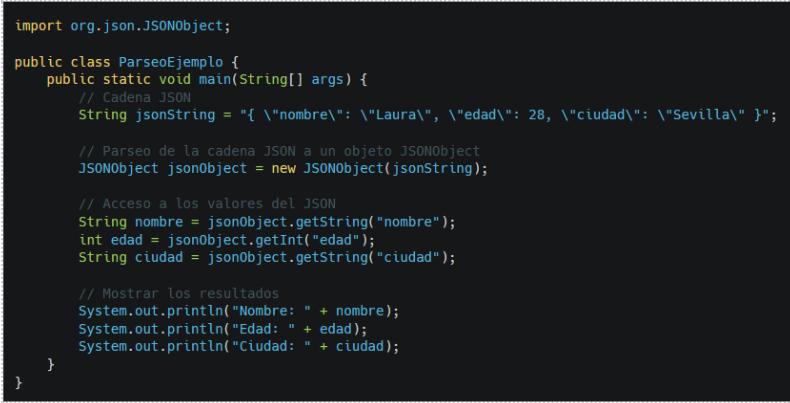
In this example using Gson, `JsonParser.parseString()` converts the JSON string into a `JsonObject`, and we then use methods such as `getAsString()` and `getAsInt()` to extract the values.
We offer you training courses related to programming languages:





 Español
  English (UK)